7 Best Materials Used in Orthopedic Implants

Time:2026-11-25 Author:Isabella
0%

Choosing an orthopedic implant is not just a matter of strength. The material must withstand repeated loading, resist wear and corrosion, and interact safely with surrounding tissue. What materials are used in orthopedic implants? The answer commonly includes titanium alloys, stainless steel, cobalt-chromium alloys, ceramics, polyethylene, and newer bioactive materials. Each serves a different purpose. A ceramic hip bearing, for example, has a smooth, hard surface; a titanium stem is valued for strength and bone integration.

Demand is substantial. Grand View Research’s Orthopedic Implants Market report estimated the global market at about $47.1 billion in 2023, with growth projected through 2030. Market size alone, however, does not tell patients which material is right for them. Implant design, surgical technique, activity level, and individual health all matter. The evidence is not one-size-fits-all.

Professor John Fisher, a biomaterials researcher at the University of Leeds, has emphasized a central design principle: orthopedic materials must balance mechanical performance with biological compatibility. That balance is easy to describe and difficult to achieve. A material may perform well in laboratory tests yet behave differently inside a living body. This guide compares seven widely used materials, explains their practical strengths and trade-offs, and highlights why implant selection should rely on clinical evidence—not marketing claims. Some details remain debated, and that deserves attention.
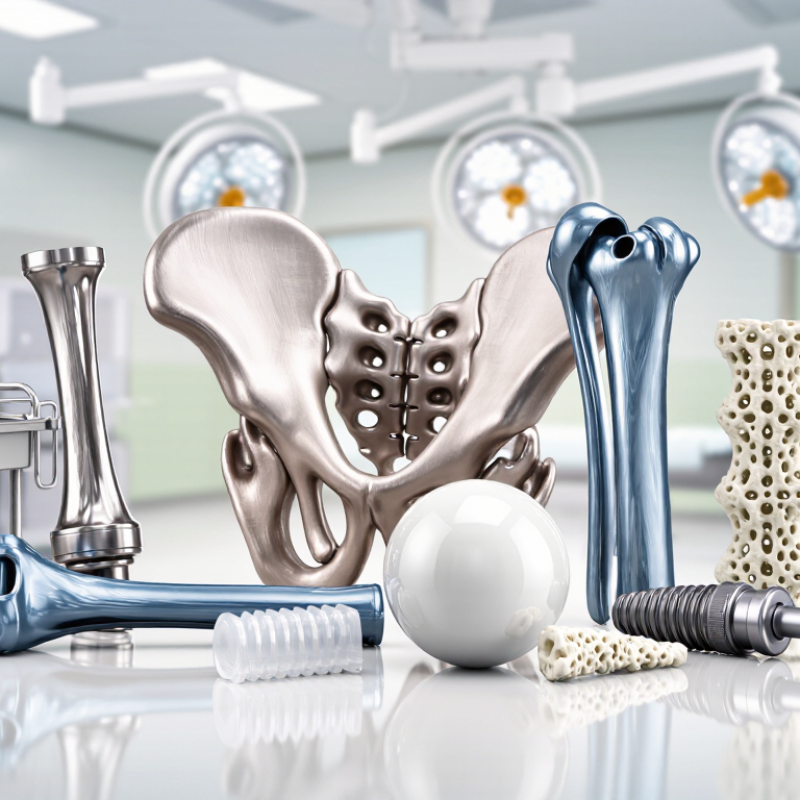
7 Best Materials Used in Orthopedic Implants

Material Requirements for Orthopedic Implants

Material Requirements for Orthopedic Implants

Orthopedic implant materials must work safely inside the body for years. They need to resist corrosion, wear, and repeated loading. Biocompatibility matters, but it is not the only test. Engineers also consider strength, stiffness, sterilization, and how the material appears in medical imaging. The right choice depends on the implant’s location and function. No material is perfect.

Titanium alloys are valued for strength and relatively low weight, while stainless steel can suit certain fixation devices. Cobalt-chromium alloys offer strong wear resistance in joint components, though their stiffness may be a concern. Alumina and zirconia ceramics can provide hard, smooth bearing surfaces, but may fracture under impact. PEEK is a polymer used in selected spinal and fixation applications. UHMWPE often serves as a low-friction bearing material in joint replacements. Each option has trade-offs; performance depends on design, manufacturing, and patient factors.

Tips: Ask how the material handles the loads and motion expected at the implant site. Check whether wear particles, imaging needs, or possible revision surgery affect the choice. Small details matter.

Metal Alloys: Titanium, Stainless Steel, and Cobalt-Chromium

Metal alloys remain central to orthopedic implants because they combine strength with manufacturing reliability. Titanium alloy, commonly Ti-6Al-4V, has a density near 4.4 g/cm³ and an elastic modulus around 110 GPa, according to ASM Handbook, Volume 2. It is notably lighter than stainless steel or cobalt-chromium. Its lower stiffness can help reduce the mismatch between an implant and bone, though it does not eliminate stress shielding. Titanium is often used in stems, screws, and porous surfaces that encourage bone attachment. A rough surface matters.

Stainless steel, including implant-grade 316L, has a density near 8.0 g/cm³ and a modulus around 190 GPa. ASTM F138 specifies wrought 316L for surgical implants. It offers good strength and corrosion resistance, often at lower material cost, but its higher stiffness may make it less suitable for some long-term load-bearing designs. Cobalt-chromium-molybdenum alloy is denser, about 8.3 g/cm³, and has a modulus near 210–230 GPa, based on ASM Handbook property ranges. ASTM F75 covers cast CoCrMo alloy. Its hardness and wear resistance make it useful in joint-bearing components. Still, no alloy is automatically the best choice: geometry, surface finish, patient activity, and corrosion behavior all matter. These figures describe typical values, not guarantees for every implant.

7 Best Materials Used in Orthopedic Implants — Metal Alloys

Representative Young’s modulus of three commonly used orthopedic implant alloys

Titanium alloys are less stiff than stainless steel and cobalt-chromium alloys, whose elastic moduli are closer to that of bone. Values are representative approximations; actual properties vary by alloy composition, processing, and material condition. Modulus alone does not determine implant suitability.

Porous Tantalum for Bone Integration

Porous tantalum is valued in orthopedic implants for its open, interconnected structure. Its tiny spaces resemble parts of cancellous bone, giving new bone room to grow into the implant surface. This process is called bone ingrowth. The material is also corrosion-resistant and generally well tolerated by the body.

The structure matters. A porous surface can provide more contact points than a smooth one, helping support mechanical fixation as healing progresses. However, integration is not automatic. It depends on factors such as bone quality, implant placement, and the patient’s healing response. Porosity alone cannot compensate for poor fit or inadequate bone support. That part is easy to overlook. Evidence and outcomes also vary by implant design and surgical context, so broad claims should be treated cautiously.

Tips: Ask your orthopedic specialist how the implant’s porous surface relates to your specific procedure. Follow the prescribed recovery plan, and report unusual pain or swelling. Bone healing takes time. No material guarantees the same result for every patient.

Ceramics: Alumina and Zirconia for Wear Resistance

Alumina and zirconia are hard, smooth ceramics used in hip joint bearings, where repeated contact can gradually wear materials. Published hip-simulator studies using ISO 14242 methods report very low ceramic-on-ceramic wear, sometimes around 0.1 mm³ per million cycles. The figure depends on the test setup, lubrication, and component design; it is not a promise of identical performance in a patient. Alumina offers excellent hardness and scratch resistance. Zirconia is tougher, partly because its crystal structure can resist crack growth. Piconi and Maccauro’s review in Biomaterials (1999) describes this transformation-toughening mechanism.

Small particles matter. The Australian Orthopaedic Association National Joint Replacement Registry’s 2023 Annual Report tracks revisions across bearing types, a useful reminder that laboratory wear is only one measure of clinical performance. Ceramics can still fracture, and edge loading or poor component positioning may increase local stress. Zirconia also requires careful material control because prolonged exposure to body fluids can alter its surface. That trade-off is real. When assessing an implant, clinicians consider patient activity, anatomy, and surgical placement alongside material properties. Bench results help, but they cannot capture every step, stumble, or years of changing movement.

7 Best Materials Used in Orthopedic Implants - Ceramics: Alumina and Zirconia for Wear Resistance
Comparison Dimension Alumina (Al₂O₃) Zirconia (ZrO₂) Relevance to Orthopedic Implants Important Consideration
Common implant form High-purity, dense polycrystalline alumina Typically yttria-stabilized zirconia, including 3Y-TZP Both are used in selected joint-replacement bearing components, particularly femoral heads for hip implants. Material choice depends on the implant design, manufacturing quality, and applicable medical-device standards.
Typical density Approximately 3.9–4.0 g/cm³ Approximately 6.0 g/cm³ for 3Y-TZP Density affects component mass and design, although it is not a direct measure of wear performance. Exact values vary with composition, porosity, and processing.
Hardness Typically about 18–20 GPa Typically about 12–14 GPa for 3Y-TZP High hardness helps ceramic bearing surfaces resist scratching and abrasive damage. Hardness alone does not predict clinical wear; surface finish, counterface, and lubrication also matter.
Fracture toughness Typically about 3–5 MPa·m1/2 Typically about 5–10 MPa·m1/2 for 3Y-TZP Zirconia can resist crack growth better than alumina through a transformation-toughening mechanism. Reported ranges depend on composition and test method; both materials remain brittle ceramics compared with metals.
Wear resistance Very good when manufactured and polished to a high-quality bearing surface Very good in suitable bearing designs; performance depends on composition and surface condition Low-wear ceramic-on-ceramic hip bearings can reduce particle generation compared with some alternative bearing couples. Wear is influenced by alignment, loading, lubrication, component damage, and the opposing bearing material.
Biological response Generally considered biocompatible and chemically stable in the body Generally considered biocompatible; stabilized zirconia is used in selected implant applications Both materials can provide hard, corrosion-resistant bearing surfaces. Biocompatibility applies to the finished, validated device and does not eliminate risks such as fracture or wear-related complications.
Key advantage High hardness and a long history of use in ceramic bearing components Greater fracture toughness than conventional alumina in many stabilized grades Each material offers a different balance of hardness, toughness, and bearing performance. Material properties should be assessed as part of the complete implant system, not in isolation.
Key limitation Limited fracture toughness means catastrophic failure is possible if a component is damaged or overloaded. Some zirconia grades can undergo low-temperature hydrothermal aging, which may affect surface and mechanical properties. Careful design, processing, inspection, and surgical handling are important for ceramic components. Performance depends on the specific ceramic grade and manufacturing process; not all alumina or zirconia products are equivalent.
Common bearing context Used in ceramic-on-ceramic and ceramic-on-polyethylene hip bearing combinations. Used in selected ceramic bearing components, including some hip applications. Pairing determines the bearing system’s overall wear behavior and clinical characteristics. Selection should be made by qualified clinicians based on patient needs and the approved device design.
Summary Best known for high hardness and wear-resistant bearing surfaces. Offers a useful combination of wear resistance and comparatively higher toughness in stabilized grades. Both ceramics are valuable options for specific orthopedic bearing applications. Neither material is universally superior; suitability depends on the device, patient, and clinical situation.

UHMWPE and How Implant Materials Are Selected

UHMWPE, or ultra-high-molecular-weight polyethylene, commonly forms the low-friction liner between a hip’s metal or ceramic ball and its socket. Under repeated movement, the ball slides across the liner like a smooth wheel on a track. The polymer must resist wear, fatigue, and chemical degradation. Cross-linking can reduce particle generation, but processing and sterilization may also affect strength and oxidation resistance. No material is perfect.

Material selection is a balancing act. Surgeons and engineers consider patient age, activity, bone quality, anatomy, and how different components interact. A younger, highly active patient may place more cycles on a bearing surface; an older patient may have different priorities. The 2023 National Joint Registry report documents more than three million recorded joint replacements, illustrating why long-term registry monitoring matters. Such records help identify differences in revision outcomes across implant types, though they cannot predict one person’s result. ISO 14242-1 also provides a standardized method for testing hip-joint wear in simulators. Real bodies are messier than test rigs. In practice, material choice depends on evidence, surgical judgment, and the trade-offs each design accepts. Some uncertainty remains.

FAQS

What qualities should orthopedic implant materials have?

They should resist corrosion, wear, and repeated loading. They also need suitable strength, stiffness, and biocompatibility. No material is perfect.

Why might titanium alloys be chosen for an implant?

They combine strength with relatively low weight. Their suitability still depends on the implant’s location and design.

When might stainless steel or cobalt-chromium alloys be considered?

Stainless steel can suit some fixation devices. Cobalt-chromium offers strong wear resistance in joint components, though its stiffness may be a concern.

What are alumina and zirconia ceramics used for?

They can form hard, smooth bearing surfaces in hip joints. Ceramic-on-ceramic tests have reported very low wear, sometimes around 0.1 mm³ per million cycles.

Does low ceramic wear in laboratory tests guarantee the same result in a patient?

No. Test setup, lubrication, and component design affect results. Real movement is less predictable.

Can ceramic implant components fracture?

Yes. Impact, edge loading, or poor positioning can increase local stress. Hard surfaces are not indestructible.

What should clinicians consider when choosing a bearing material?

They may weigh activity, anatomy, expected motion, and surgical placement. Wear particles and imaging needs can also matter.

Why do revision surgery and imaging needs affect material choice?

Material properties may influence later assessment or revision planning. These details deserve attention, even when they are easy to overlook.

What roles can PEEK and UHMWPE serve?

PEEK is used in selected spinal and fixation applications. UHMWPE often provides a low-friction bearing surface in joint replacements. Each has trade-offs.

Conclusion

What materials are used in orthopedic implants depends on the implant’s purpose, the forces it must withstand, and how it interacts with the body. Common choices include titanium alloys, stainless steel, and cobalt-chromium alloys, valued for their strength and durability. Porous tantalum can encourage bone to grow into its structure, helping support integration, while alumina and zirconia ceramics offer hardness and resistance to wear in applications where smooth, durable surfaces are important.

Ultra-high-molecular-weight polyethylene (UHMWPE) is often used as a low-friction bearing material, particularly in joint components. Selecting an implant material involves balancing strength, wear resistance, biocompatibility, and the ability to support bone attachment. The best choice varies according to the implant’s design, location, expected loading, and the patient’s needs. Together, these materials help engineers create implants suited to different orthopedic applications.

Isabella

Isabella

Isabella is a dedicated marketing professional with a sharp focus on driving brand growth and engagement through strategic content creation. With an extensive background in digital marketing, she combines her passion for storytelling with her keen understanding of industry trends to deliver......