Kirschner Wires, often called K-wires, are essential tools in orthopedic surgery. These thin stainless steel wires are used for fixation and stabilization of bone fragments. According to a recent industry report, the global orthopedic wire market is projected to reach $1.9 billion by 2026, emphasizing the growing reliance on such devices in surgical procedures.
The unique flexibility and strength of Kirschner Wires make them ideal for various applications. They can be used in percutaneous pinning, fracture management, and even in certain soft tissue repairs. Their ability to provide temporary stabilization has become a standard practice in many surgical environments. However, surgical outcomes are not always perfect. Complications like infection or wire migration can occur, thus requiring careful preoperative planning and technique.
Despite their efficacy, the usage of Kirschner Wires presents challenges. Surgeons must consider the patient's specific anatomy and overall health. Careless insertion could lead to significant issues. The evolution of surgical techniques and technology continues to shape how Kirschner Wires are utilized. Ongoing research is necessary to refine these practices further, ensuring optimal outcomes in orthopedic surgery.
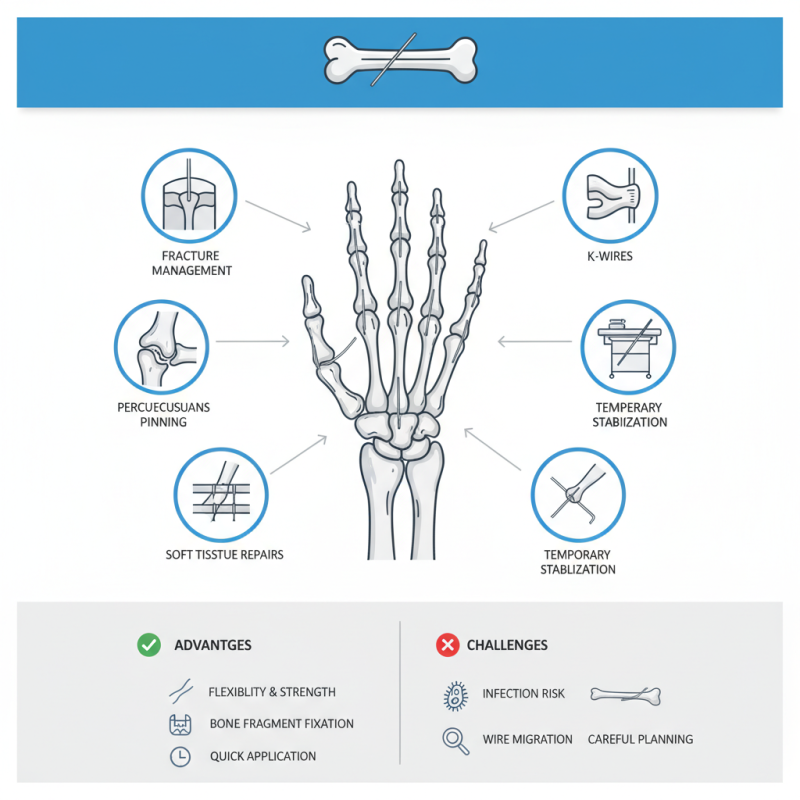
Kirschner wires, commonly known as K-wires, are slender metal rods used in surgical procedures. They are primarily made from stainless steel. These wires serve to stabilize bone fragments during healing. Their flexibility and strength make them valuable in orthopedic surgery. Surgeons often use K-wires in fracture fixation, especially in the hand and foot.
Tips: Choosing the right diameter for K-wires is crucial. A wire that's too thin may bend or break. One that’s too thick could damage surrounding tissue. Always consider the specific needs of each patient.
These wires can be inserted percutaneously, meaning through the skin. This minimizes surgical trauma and enhances recovery time. However, improper placement can lead to complications. Continuous reflection on past experiences is vital for improving outcomes. Tracking patient feedback and results can guide future procedures.
The historical development of Kirschner wires in surgery dates back to the early 20th century. These thin, flexible wires were introduced by Dr. Martin Kirschner in 1909. Initially, their primary use was for skeletal fixation in orthopedic surgeries. Over the decades, advancements in materials and surgical techniques have cemented their place in modern medicine. Today, these wires play a critical role in various surgical procedures.
In recent reports, approximately 80% of orthopedic surgeons utilize Kirschner wires for fractures involving small bones. Their ability to provide stable internal fixation has made them indispensable. However, their use is not without challenges. Complications like pin tract infections can occur, and there is a continuing debate on wire gauge and performance.
Innovations in surgical practices have emerged, but the basic principles of Kirschner wire usage remain unchanged. Some surgeons argue the need for alternative fixation methods to minimize infection risk. While Kirschner wires have proven effective, the pursuit of improved outcomes is ongoing. Adapting techniques and continually evaluating their effectiveness helps in addressing existing gaps in patient care.
Kirschner wires, often referred to as K-wires, are crucial in orthopedic surgeries. They offer stability and alignment during the healing process. When it comes to their materials, stainless steel is the most common choice. It ensures strength and resistance to corrosion. Some advanced options include titanium, which provides excellent biocompatibility. Industry reports indicate that stainless steel K-wires have a tensile strength of around 700 MPa, making them robust for surgical applications.
Manufacturing standards for K-wires are vital. They should adhere to ASTM F138 standards which ensure quality and safety in medical devices. As per data from the American Society for Testing and Materials, these standards focus on dimensional tolerances and surface finish. A surface that's smooth minimizes tissue irritation. However, not all manufacturers consistently meet these standards. This inconsistency may lead to complications.
Tips: Always check for compliance with established standards before use. They impact the overall success of the surgery. Be aware of different wire gauges available, ranging from 0.8 mm to 3.0 mm. This variety allows for tailored applications. Remember, using the wrong gauge in surgical setups might lead to inadequate stabilization, potentially prolonging recovery. Quality control in the manufacturing process is key to reducing the risks associated with K-wires.
Kirschner wires, commonly known as K-wires, play a vital role in orthopedic surgeries. These thin metal pins are used to stabilize fractured bones. According to a report from the American Academy of Orthopaedic Surgeons, approximately 30% of patients with bone fractures benefit from K-wire fixation. This technique is minimally invasive yet highly effective.
In pediatric surgery, K-wires are frequently employed in treating fractures. Data reveals that they reduce recovery time by up to 20% compared to traditional methods. A study in the Journal of Pediatric Orthopaedics found that K-wire usage decreases complications in children by nearly 15%. However, the limitations of K-wires include potential infection risks and misplacement.
In adult cases, K-wires can aid in managing complex fractures. Yet, about 10% of patients experience issues with wire irritation. This makes careful insertion crucial. Surgeons must weigh the benefits against the chances of such complications. The presence of K-wires has undeniably transformed surgical practices. Their application highlights the balance between innovation and potential drawbacks in orthopedic surgery.
Kirschner wires, often referred to as K-wires, are thin, metallic pins used in orthopedic surgeries. They help stabilize fractures and support bone alignment. While they are effective tools, their usage is not without risks. Complications can arise during placement or after post-operative recovery.
One common complication is infection. The exposed ends of K-wires can serve as pathways for bacteria. This risk increases if the wire is left in place for too long. Additionally, improper placement can lead to nerve damage or vascular complications. Surgeons must be cautious and meticulous during insertion to minimize these risks.
Another consideration involves pain management. Some patients report discomfort after the procedure as the body reacts to the foreign object. Monitoring the patient’s response is crucial. Regular follow-ups are essential to ensure successful healing. In some cases, K-wires may need to be removed earlier than planned, which adds complexity to the treatment. Balancing benefits against potential drawbacks remains a core challenge in their use.
: Stainless steel is the most common material for K-wires. It provides strength and corrosion resistance.
K-wires should follow ASTM F138 standards to ensure safety and quality in medical applications.
A smooth surface minimizes tissue irritation and potential complications during healing.
Complications include infections, nerve damage, and discomfort after surgery.
K-wires come in various gauges from 0.8 mm to 3.0 mm. The wrong gauge can hinder stabilization.
Quality control is vital to reduce risks associated with K-wire complications during surgery.
Infection can occur, especially if K-wires are left in place for too long.
Caution and meticulous technique are key to minimizing risks during insertion.
Monitoring for discomfort is essential, as many patients experience a reaction to the wires.
Some patients may require earlier removal due to complications, adding complexity to treatment.
Kirschner wires, commonly referred to as K-wires, are thin, pointed wires used in various surgical procedures for the purpose of fixation and stabilization of bone fragments. These wires have evolved significantly since their initial introduction, with advancements in materials and manufacturing standards ensuring higher reliability and effectiveness. Today, they are primarily made from stainless steel or other biocompatible materials, allowing for safe integration within the human body.
The applications of Kirschner wires are extensive, particularly in orthopedic and trauma surgeries, where they play a crucial role in fracture management and joint stabilization. Statistical data highlights their effectiveness and common usage scenarios, although potential safety concerns and complications must be considered. Overall, Kirschner wires remain a vital tool in modern surgical practices, facilitating recovery and improving patient outcomes.

Pure Orthopedic Implants