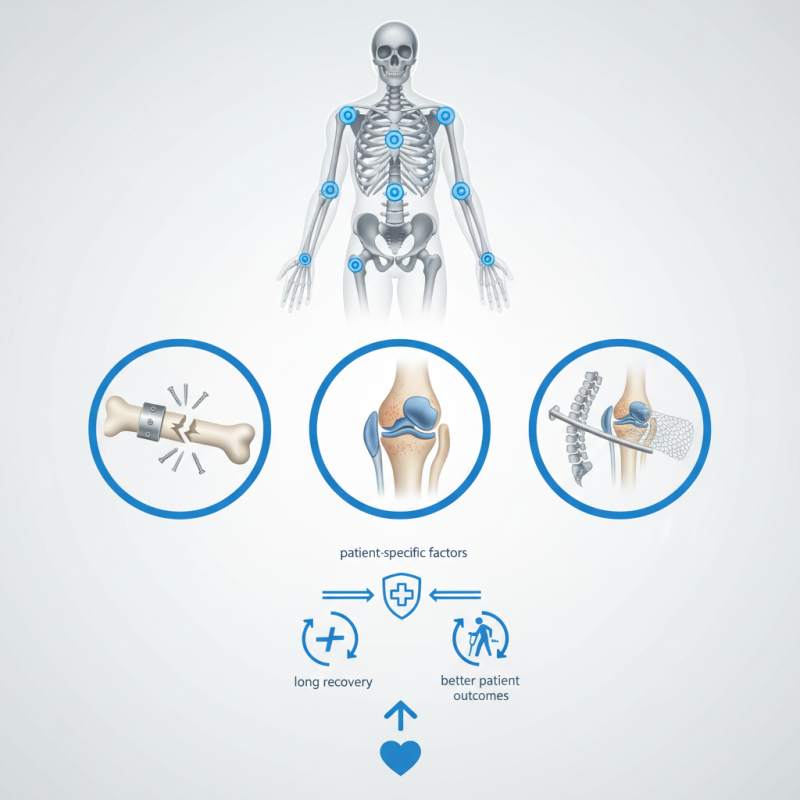
Orthopedic implants play a crucial role in modern medicine. A report from the World Health Organization states that millions undergo procedures involving these implants each year. But what conditions are treated with orthopedic implants? According to Dr. Emily Roberts, an orthopedic surgeon with over 15 years of experience, "Orthopedic implants address diverse conditions, primarily fractures, degenerative diseases, and joint instability."
Fractures, especially compound or complex ones, often require stabilization. For example, hip fractures are prevalent in older adults. Degenerative conditions like arthritis can lead to joint replacements. Implants provide support, but complications can arise, such as infections or rejection.
We must consider patient-specific factors when deciding on implants. Dr. Roberts emphasizes, "Each patient's unique condition influences implant selection." The journey is not always straightforward; some patients face long recovery periods. Evaluating the specific conditions treated with orthopedic implants is vital. This ensures tailored care and better patient outcomes.
Introduction to the Concept of Artificial Intelligence
Artificial intelligence (AI) is a dynamic field that is reshaping our lives. It involves creating machines capable of mimicking human intelligence. These machines can learn, reason, and adapt from experiences. In recent years, AI has gained momentum, influencing industries like healthcare, finance, and transportation.
Understanding AI is crucial. There are various approaches to developing intelligent systems. Some rely on algorithms that analyze vast datasets. Others focus on neural networks inspired by the human brain. Despite its potential, the path to effective AI is riddled with challenges. Creating reliable and unbiased systems requires meticulous effort.
Ethical considerations are equally important. The impact of AI on society cannot be understated. Decisions made by AI systems can affect individuals in profound ways. This raises questions about accountability and fairness. As we stand on the cusp of this new technological frontier, we must ponder the implications of AI. What does it mean for our future? How can we ensure it serves humanity positively? These reflections compel us to engage critically with AI development.
Historical Development of Artificial Intelligence Technologies
The historical development of artificial intelligence (AI) technologies showcases a remarkable journey. This evolution began in the mid-20th century. Early innovations focused on symbolic reasoning and problem-solving. Research by John McCarthy and others laid foundational theories of AI. For instance, processing speed and data availability were significant challenges then.
Fast forward to the 21st century, AI has made substantial strides. A report from McKinsey highlights that over 60% of companies are adopting AI in some capacity. However, while progress is evident, not all applications yield success. The failure rate of AI projects can be as high as 85%. Many organizations struggle with integration. Issues often arise due to lack of skilled professionals and clear strategy.
Moreover, ethics in AI remains a critical concern. As AI technologies evolve, so do ethical dilemmas around data privacy and bias. A survey by the AI Now Institute revealed that 76% of experts express concern over algorithmic fairness. Engaging in a thoughtful discourse on these challenges is essential. Adopting AI responsibly necessitates ongoing dialogue among stakeholders.
Historical Development of Artificial Intelligence Technologies
Key Applications of Artificial Intelligence in Various Sectors
Artificial Intelligence (AI) is transforming various sectors by enhancing efficiency and decision-making. In healthcare, AI algorithms analyze medical data to predict diseases. For instance, early detection of conditions like diabetes can save lives. This technology also assists radiologists in identifying abnormalities in imaging. However, there are concerns about data privacy and algorithm transparency.
In finance, AI streamlines risk assessment and fraud detection. Anomalies in transaction patterns are flagged quickly. These systems process vast amounts of data faster than humans. Yet, over-reliance on AI might overlook nuanced human judgment in certain scenarios. Balancing technology with human expertise remains essential.
Manufacturing benefits from AI through predictive maintenance and automation. Smart machines can forecast equipment failures, reducing downtime. This leads to significant cost savings. However, job displacement remains a difficult issue. Training workers to adapt is crucial yet often neglected, creating a gap in the workforce. Each application of AI comes with its own challenges and requires thoughtful integration.
Key Applications of Artificial Intelligence in Various Sectors
| Sector |
AI Application |
Benefits |
| Healthcare |
Medical Diagnosis |
Improved accuracy and speed in diagnosing diseases. |
| Finance |
Fraud Detection |
Enhanced security and reduced financial losses. |
| Retail |
Personalized Recommendations |
Increased customer satisfaction and sales. |
| Manufacturing |
Predictive Maintenance |
Reduced downtime and maintenance costs. |
| Transportation |
Autonomous Vehicle Systems |
Improved safety and transportation efficiency. |
| Education |
Adaptive Learning Systems |
Customized learning experiences and better outcomes. |
Ethical Considerations and Challenges in AI Development
The rapid advancement of artificial intelligence raises significant ethical questions. Developers must consider the long-term implications of their creations. Algorithms that optimize efficiency can inadvertently reinforce bias. This reality challenges the notion of neutrality in technology.
Transparency is a major concern in AI deployment. Many algorithms operate as black boxes, obscuring decision-making processes. Users of AI tools often remain unaware of underlying biases. This lack of clarity can lead to mistrust and reluctance, particularly among marginalized communities. Ethical AI demands accountability and inclusivity in design.
Moreover, the AI field is plagued by ethical dilemmas surrounding data privacy. As systems analyze vast amounts of personal information, individuals’ rights may be compromised. Striking a balance between innovation and privacy is not straightforward. Continuous reflection on these ethical challenges is essential for responsible AI development.
Future Trends and Innovations in Artificial Intelligence
The future of artificial intelligence (AI) is poised for transformative advancements. One of the most exciting trends is the shift towards more human-like AI interactions. This evolution aims to make technology more accessible and intuitive. Imagine AI systems that understand emotions and respond in ways that feel natural. It can enhance customer service, therapy applications, and user experience across various sectors.
Another area of innovation involves AI's role in healthcare. AI algorithms are being developed to analyze medical data with incredible precision. They can predict diseases before symptoms appear, leading to proactive treatment options. However, reliance on these systems raises ethical questions. Can we trust AI to make life-altering decisions? Understanding its limitations becomes crucial, as biases in training data can skew results.
AI is also exploring creativity, generating art and music that challenge traditional boundaries. As these technologies advance, they may blur the lines between human and machine creativity. This prompts reflection on authorship and originality. As we integrate AI deeper into our lives, the need for ethical frameworks grows. Balancing innovation with responsibility is essential in navigating this uncharted territory.
FAQS
AI enhances risk assessment and fraud detection by quickly identifying anomalies in transaction patterns.
Yes, job displacement is a key issue. Training for new roles is often ignored, creating workforce gaps.
Transparency helps users understand AI decision-making processes and can reduce trust issues among communities.
Algorithms can unintentionally reinforce biases, challenging the belief that technology is entirely neutral.
AI often analyzes extensive personal data, potentially violating individuals' rights and privacy.
Over-reliance on AI may diminish important human judgment in some scenarios.
They must prioritize accountability and inclusivity, considering long-term implications of AI technologies.
It uses AI to forecast equipment failures, which can significantly reduce downtime and save costs.
Lack of awareness of biases in AI can lead to mistrust, complicating technology's acceptance and use.
Conclusion
This article provides a comprehensive overview of artificial intelligence (AI), beginning with an introduction to its fundamental concepts and tracing its historical development over the years. It highlights various applications of AI across multiple sectors, such as healthcare, finance, and transportation, emphasizing how these technologies have revolutionized processes and decision-making.
Additionally, the discussion delves into ethical considerations and challenges that arise in the development and deployment of AI systems, urging a balance between innovation and responsibility. As the article looks toward the future, it outlines emerging trends and innovations that could further enhance AI's capabilities. In the context of healthcare, AI plays a crucial role in orthopedic fields, particularly in determining what conditions are treated with orthopedic implants, thereby improving patient outcomes through enhanced diagnostic tools and treatment planning.

 Pure Orthopedic Implants